
While we were vacationing in France, the weather Gods graced us with rain after months of drought. Lots of rain. Apparently, it rained every morning, and the sun broke cover in the afternoon. Needless to say, we returned home not only to a greener garden but also to a proliferation of mosquitoes!
The usual suspects, such as Hibiscus and Diplandenia, are still flowering, as are the Crown of Thorn cacti, so rather than create yet another post featuring these, I will feature six succulents. My thanks to Google Lens, which not only helped me identify them but also offered tips for their survival that I’d previously overlooked..
Agave attenuata, also known by common names such as foxtail agave, lion’s tail, or swan’s neck agave.
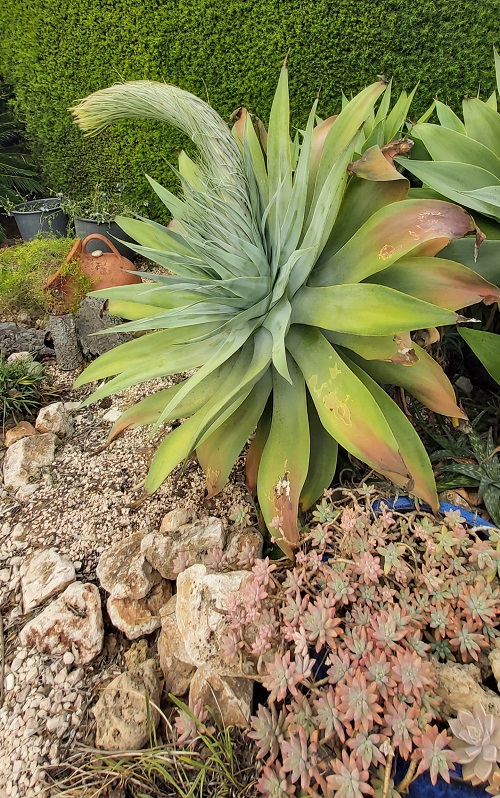
The plant is a succulent perennial native to central Mexico and is characterised by its large rosettes of soft, thorn-free, grey-green leaves. The long, curved stalk emerging from the centre of the plant is its flower spike. Unlike most agave species, which have tall, vertical flower stalks, the Agave attenuata has a curved one, which gives it its common names such as foxtail, lion’s tail and swan’s neck. The rosette-type plant flowers only once, usually when the plant is about 10 years old, and dies after flowering. Yes, I concur this plant must be about ten years old.
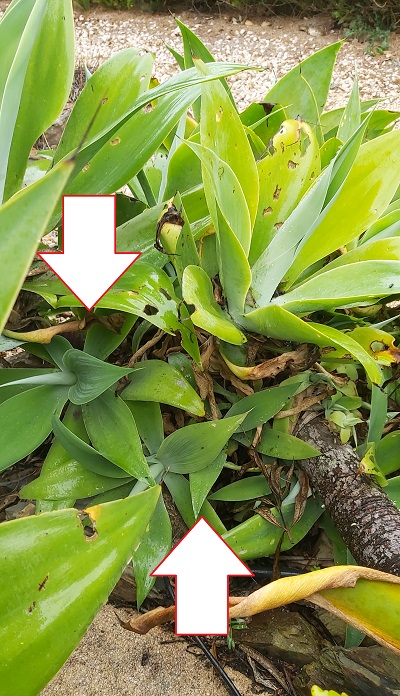
New plants (pups) grow from offsets at the base. Yep, my Agaves have had numerous babies, which do cause overcropping. Taking these pictures, I note my Agave attenuates need attention.
Very easy to propagate and probably why I have so many doted around the garden.
Othonna Capensis (Ruby Necklace)
The plant shown in the image is likely a succulent called Othonna capensis, commonly known as “Ruby Necklace” is a trailing succulent which produces small, yellow, daisy-like flowers on long stalks.
It grows well in hanging baskets or as a ground cover.
Growing in semi-shade

Growing in full sun the leaves turn reddish purple.
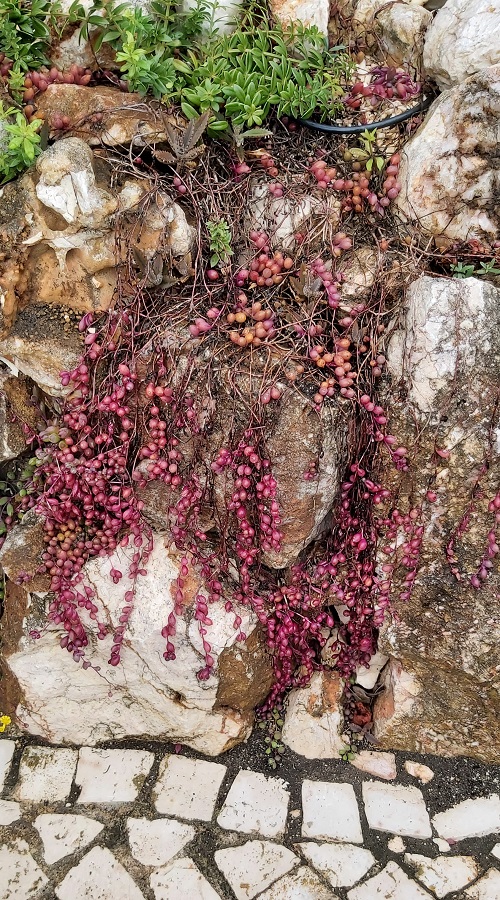
In a hanging basket. Only enjoys the late afternoon sun in the summer.
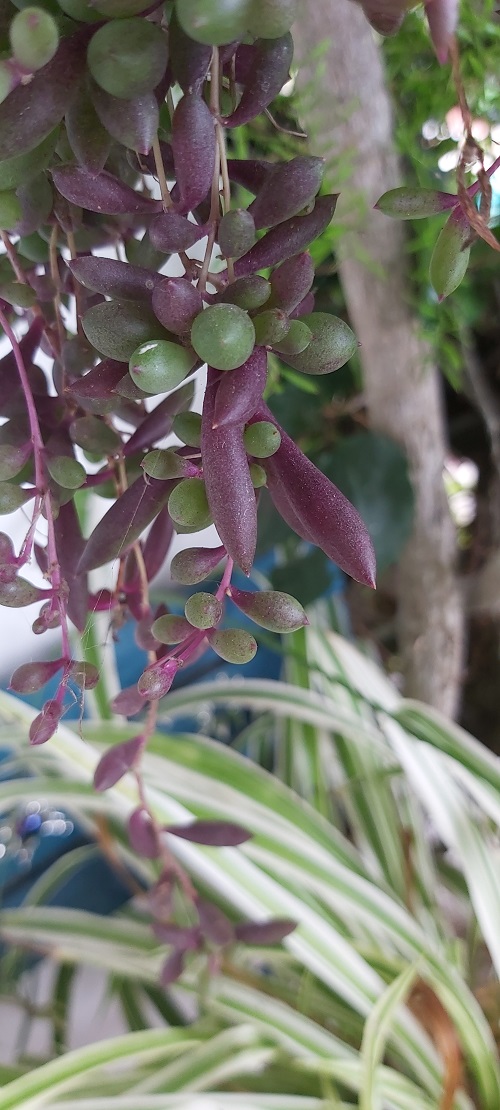
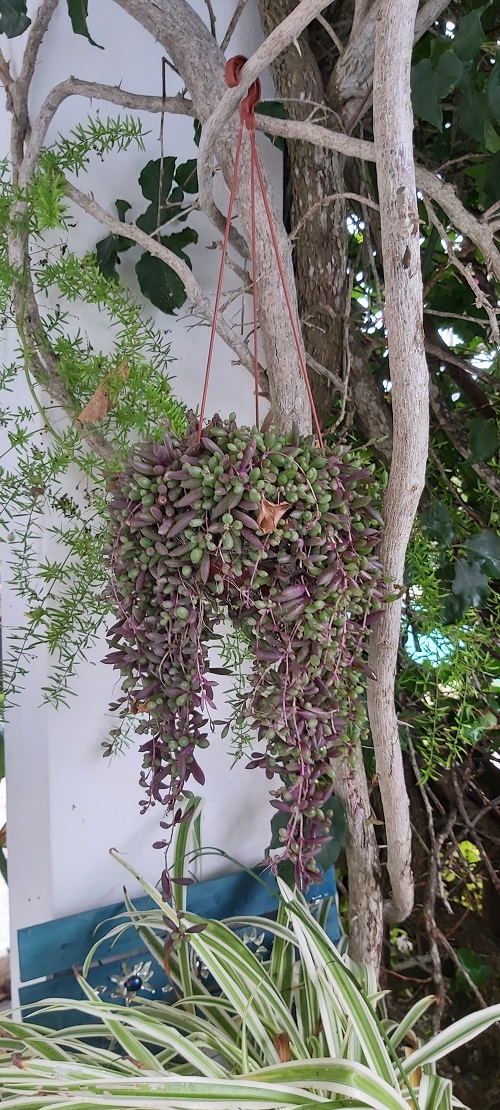
I love this succulent. It is easy to propagate and adapts well to full sun, semi-shade or shade.
Crassula Capitella ‘Campfire’
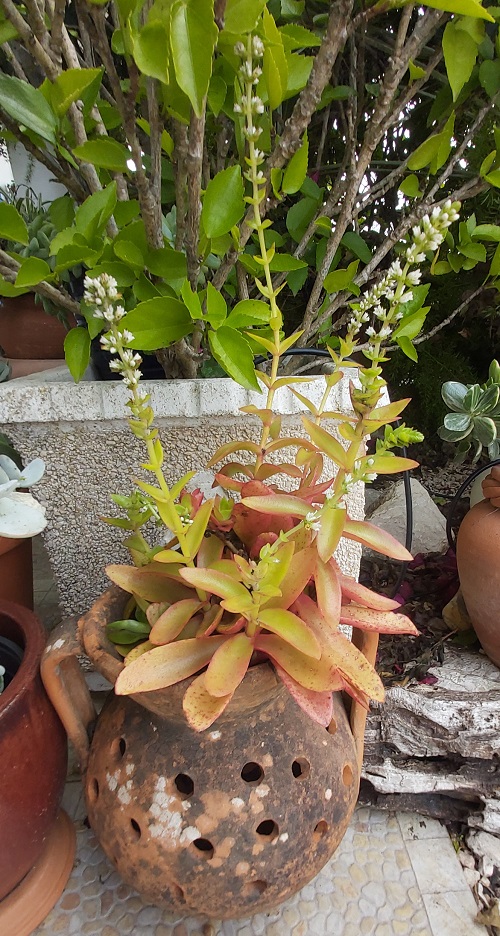
Crassula capitella ‘Campfire’ is also referred to as the Campfire Plant, Red Pagoda, or Red Flames.
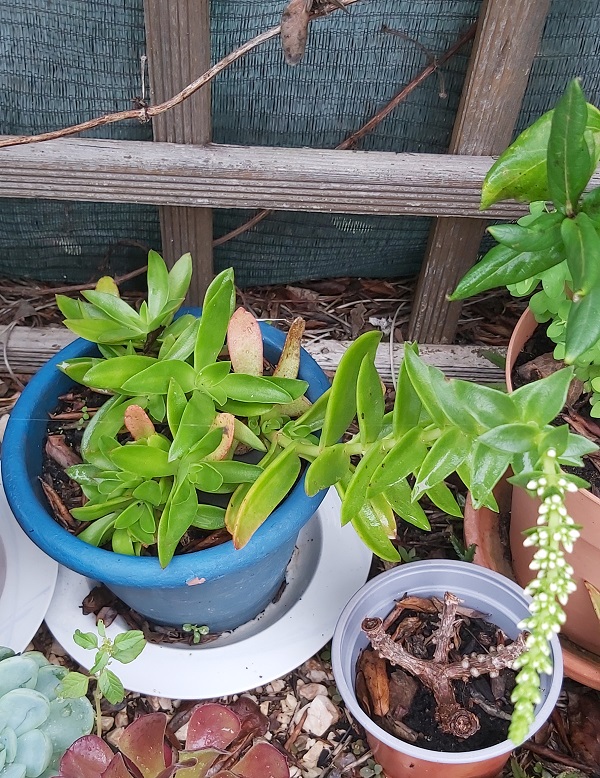
It is a low-growing, branching plant with fleshy, propeller-shaped leaves that form rosettes. The leaves change colour from a lime green to a vibrant red or orange, especially when exposed to direct sunlight or cooler temperatures.
I have never had any success planting these directly in the soil. Both the plants pictured below grow in semi-shade so I have no idea why there is a colour difference.
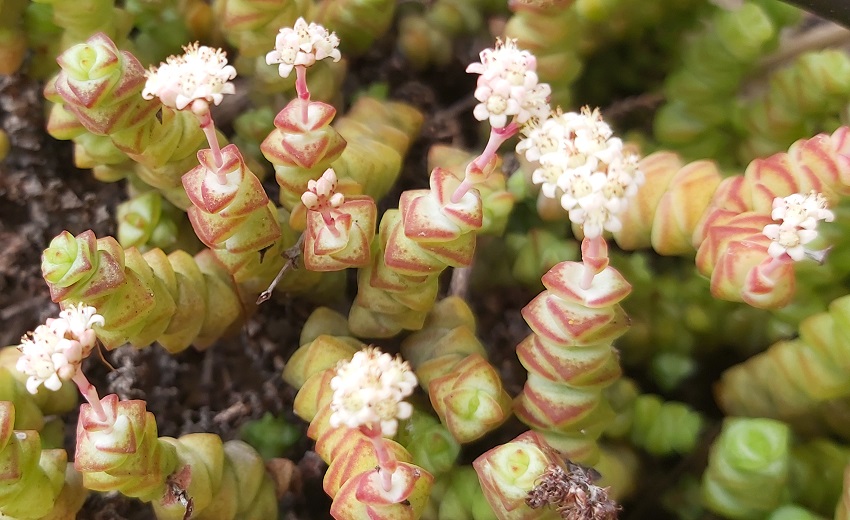
Crassula
I am unsure which one. I planted it about eight years ago when we created the pool rockeries. It is drought-tolerant and grows in full sun.

*
Echeveria ‘Mandala’
Google Lens was sending me around the houses, telling me this plant was an Aeonium. Eventually, I found it through a long-winded internet search on Picturethisai.com
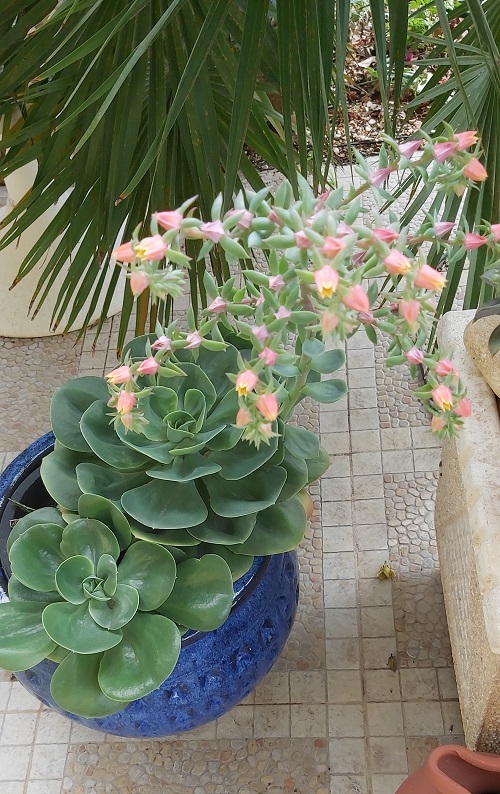
“A key special care point is ensuring adequate lighting; echeveria ‘Mandala’ thrives in bright, indirect sunlight to maintain its vibrant colors and compact growth. Overwatering is a common issue, so it’s crucial to use a well-draining soil mix and to water only when the soil is completely dry. Despite these considerations, Echeveria ‘Mandala’ is generally an easy plant to care for, suitable for beginners.”
The plant pictured above grows in indirect sunlight.
But in the next section of picturethisAI, I am informed:  Sunlight Requirements: Full sun. Watering every three weeks.
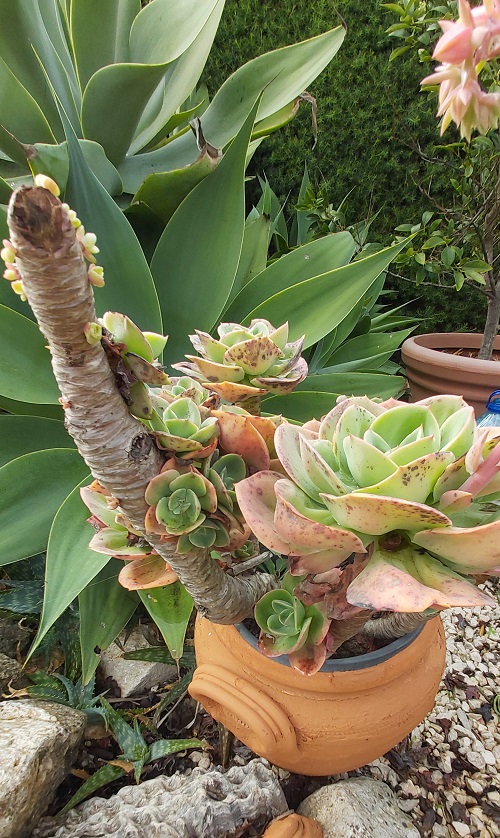
So a contradiction re sunlight. From my own personal experience, it does not enjoy full sun. This is what happens
Euphorbia Milii
I LOVE this succulent. I first saw it while on holiday in Lanzarote, and on returning to Portugal, I found they were readily available in most garden centres. In Portugal, I discovered the popular name is Wedding Mattress. It is also referred to as Well-married, Crown-of-Christ, Crown-of-thorns, Two-brothers, Martyrdoms
It grows well in half-shade or full sun and flowers year-round.
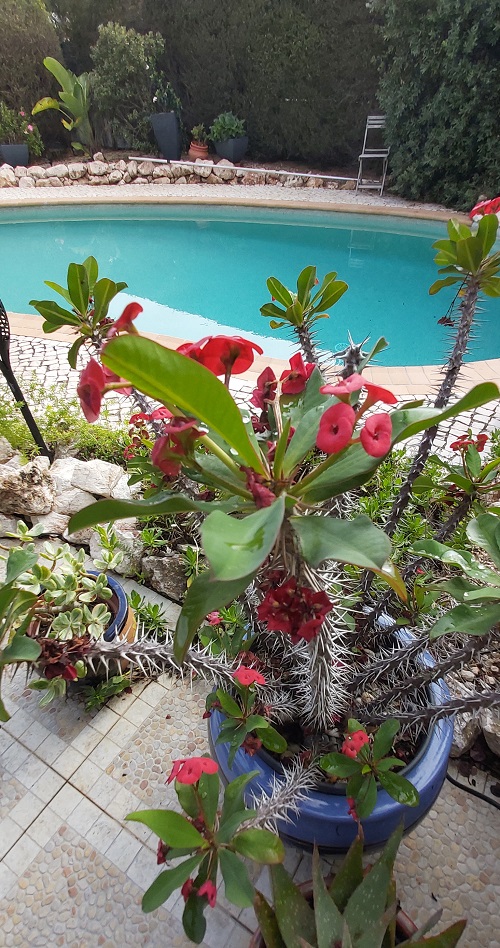
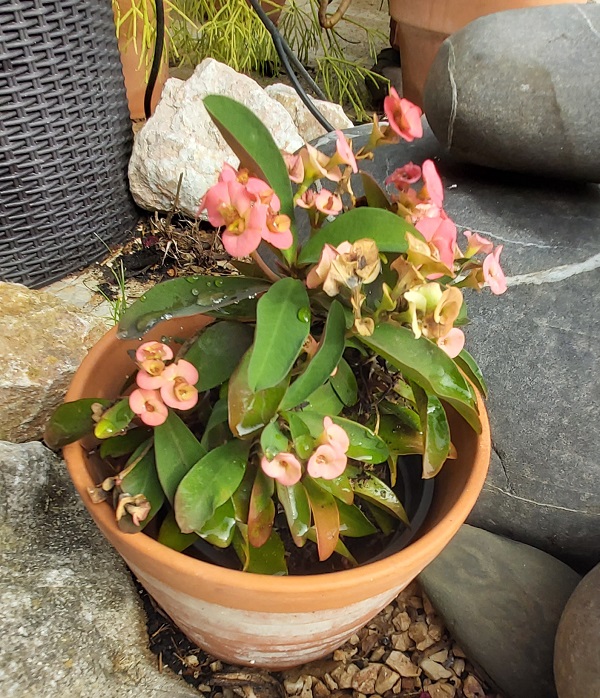
There is a minimum recommended temperature of 10 °C, but so far (touch wood), I have never had a problem when nighttime temperatures have dipped below 10 °C
My Euphorbia Milii thrive better in pots, although I have read they are also used as a ‘living hedge‘
That’s my gardening six for this Saturday, folks.
I did use AI to help identify some plants but ALL the photographs are mine taken today.
Do join other Six on Saturday bloggers over at Garden Ruminations
Related Posts:

 Piglet in Portugal
We share a lot of the same plants. We refer to that Crassula as ‘baby’s necklace’. I’ve never heard of Wedding Mattress, that’s funny as I wouldn’t want to sleep on those thorns!
LikeLiked by 1 person
Hi Tracy, yes, looking at your amazing succulent and cacti garden we certainly do! Although, I think some struggle with salty sea winds here.
LikeLike
Yes, I thought wedding mattress was a strange name, too
LikeLike
Hello, I have most of these succulents in my greenhouse (except for the euphorbia), but none of them have flowered yet except for the echeveria… Thank you for showing us the flower stalk of the Agave attenuata; I didn’t know it was curved. Mine are 2 years old, and I still have to wait 8 years to see them flower! 😂
LikeLiked by 2 people
From memory the agave flower will take weeks to appear. The stalk is huge. The only problem it will hang over the drive. Yep, if my sources are correct ten years. I never realised. Probably why I haven’t seen it flower in years. Lucky I didn’t cut it back when I saw there was problems with the leaves.
LikeLiked by 1 person
Yours look amazing! Sadly we both forgot to bring in the big pot of succulents and they didn’t survive the snow. We’ve had them for 15 years…😔
LikeLiked by 1 person
Thanks, Bernie. What a shame about your succulents! Hopefully you will start again next spring.
LikeLike
I love that close up of the Crassula with it’s geometric block-like stems. Fascinating things plants.
LikeLiked by 1 person
They certainly are, Trowel. IT is surprising how taking closeups can often reveal some interesting features.
LikeLiked by 1 person
Thanks for the tour of your succulents and all of the info, Carole. Many of these thrive here in the Rio Grande Valley. Two years ago, I was given a Crown of Thorns cutting by neighbours who have a large plant in the soil in front of their house. Mine was planted in the exact same light exposure as theirs and planted at the same time of year as theirs, but didn’t survive past the first bloom. It’s likely a soil issue, so I’ll try again after we treat the soil a bit. I have other new plants that are surviving, and one day, I’ll do a post about them.
LikeLiked by 1 person
Hi Terry, what a shame about the cutting not surviving. I confess some of my Crown of Thorns bought from the garden centres have not survived and I’ve never tried to take cuttings. I didn’t know you could.
It will be interesting to see what type of plants you grow in your Texas garden
LikeLiked by 1 person
Never knew new plants were called pups!
LikeLiked by 1 person
Laughing, neither did I! Although, I don’t know whether the name just refers to Agaves
LikeLiked by 1 person
All over – I looked it up!
LikeLiked by 1 person