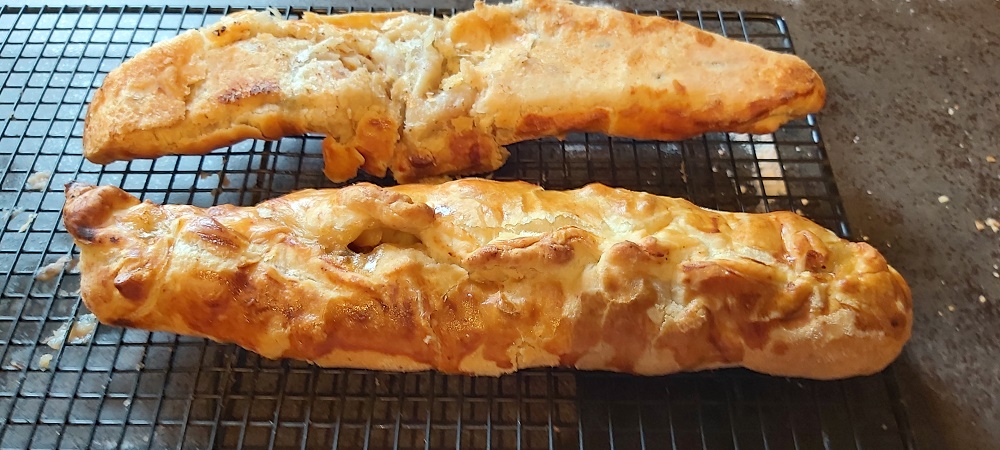
They say a way to a man’s good books is through his stomach. This is what I was banking on when I offered to make Mr. Piglet some Cornish pasties in return for his driving me down to Lagos once again on Saturday night to enjoy music at the Marina.
I mean, how hard could it be to make Cornish pasties? Besides, I don’t like him eating processed pies, which was his plan… And when I was younger (40 years ago), I used to cook dozens of pies every week to sell at the W.I. Friday market. Sadly, I lost the recipe when we moved so I blagged the recipe and cheated by buying prepackaged fresh pastry, which proved to be too thin, too stretchy and a total disaster.
I also precooked all the veg and meat. Another NO…NO… and as Mr. Piglet pointed out, I managed not only to use nearly every pot, pan and utensil we owned, but I got flour and gloop everywhere.
My pasties would not win any awards for presentation, especially as they all stuck to the baking tray and broke in half. However, Mr. P said they were delicious. Anyway, next time I make them, I will follow this recipe, make my own pastry, and not precook the meat and vegetables.
The History of the Humble Cornish Pasty
The Cornish pasty is best known as the portable meal of Cornish tin miners in the 18th and 19th centuries. The crimped edge wasn’t just decoration—it gave miners a “handle” they could grip with dirty, possibly arsenic-dusted hands and then toss away. Inside was usually a sturdy filling: beef, potato, swede (rutabaga), and onion. It was dense, warming, and enough to keep someone going through a long shift underground.
But it goes back further than the mines. There are records of pasties in England dating back to at least the 13th century, although those early versions were more of an upper-class dish, often featuring fancy fillings such as venison or even fruit. It wasn’t until Cornwall’s mining boom that the pasty became strongly tied to working-class life.
When Cornish miners emigrated—to South Africa, Mexico, the U.S., Australia—they took the pasty with them. You’ll still find versions in those places, often tweaked with local flavours.
Now, the Cornish Pasty has EU Protected Geographical Indication (PGI) status (since 2011), meaning to be called a true “Cornish Pasty,” it must be made in Cornwall and follow the traditional recipe and shape.
Related Posts:

 Piglet in Portugal
I miss these. Saved the recipe. Thanks for the memories and nostalgia.
LikeLiked by 1 person
It’s surprising what food we miss from home
LikeLiked by 1 person
I’ve never had a Cornish pasties – but anything cooked in pie crust is a win! Pastry dough can be so fussy, it’s too bad there isn’t a reliable premade frozen one, but they are NEVER as good as homemade.
LikeLike
Tracy, you need to try and bake some pasties. They are SO delicious.
LikeLike
Well, as my Dad was born and raised in Newquay it goes without saying that while growing up pasties were a regular feature on the family menu.
They still are at our place although for me no meat, of course.
LikeLiked by 1 person
Hi Ark, curious :) so what filling do you use in your pasties?
LikeLike
Usually a veggie burger (cut up) or similar and the rest ordinary veggies-potatoes, carrots, peas.
LikeLiked by 1 person
In the Upper Peninsula in Michigan, USA, Cornish Pasties are the local treat. You see signs advertising them on every street corner. In eastern Canada, we have tourtiere, which is also a meat pie, but not hand held. Thinks for sharing your experience and the recipe for pasties Carole. A few times each winter, I like to make a themed dinner for guests. This winter, Cornish Pasties will be featured in one of them.
LikeLiked by 1 person
I didn’t know you got Cornish pasties in the US!
LikeLiked by 2 people
I wonder how Cronish pasties became so popular in Michigan? The themed dinner sounds fun. Now you need a tradional English starter and dessert :)
LikeLiked by 1 person
Professor Google says that Cornish Miners immigrated to Michigan to work in the mines there, so they brought the meat pie recipe with them. Yes, the themed dinners are always fun! I’ll welcome suggestions for a traditional English starter and dessert, Carole.
LikeLike
I wonder if they immigrated because they were shutting a lot of the mines in Cornwall.
I will think about the starters and desserts. I was going to say apple pie but that is two pie dishes. Let me check out bread and butter pudding and trifle
LikeLiked by 1 person
English trifle
https://inthevintagekitchen.com/tag/english-trifle/
or Bread and butter pudding
https://en.wikipedia.org/wiki/Bread_and_butter_pudding
LikeLiked by 1 person
Thanks so much, Carole! I’ve made trifle and bread pudding before, but not traditional English recipes, so I appreciate these 😊
LikeLiked by 1 person
The other recipe I used to have as a child was spotted dick
https://en.wikipedia.org/wiki/Spotted_dick
LikeLiked by 1 person
That’s one I’ve never heard of, Carole. Thanks for sharing 😊
LikeLiked by 1 person
Even experienced home cooks occasionally have mishaps. I know I sure do.
LikeLike
Yep, and it seems at times I get more than my fair share at times :)
LikeLiked by 1 person
I know the feeling. I have been cooking for nearly 50 years, and it’s the same way with me.
LikeLiked by 1 person