With a name like Piglet, you’ve probably gathered I love food, whether it’s growing, cooking, or eating out. More recently, as part of my drive to get fit, I have been researching the health benefits of different ingredients, experimenting with new recipes, and logging some of my successes and disasters on Foodie Friday.
ARE HARD-COPY RECIPE BOOKS STILL POPULAR?
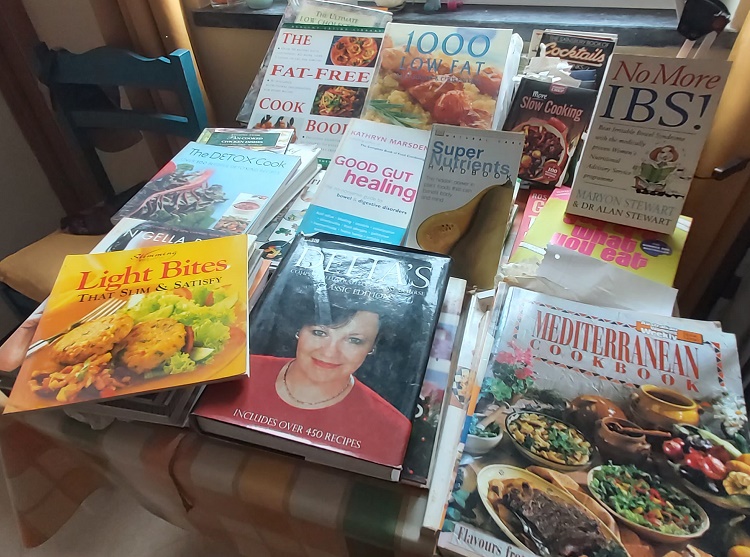
I usually find recipes online on platforms such as Pinterest and Facebook, posted on blogs I follow, or wherever. I don’t know why; perhaps it’s easier than trawling through hard-copy cookbooks, of which, at one point, I had over fifty in my collection. Several years ago, one of my favourite pastimes was browsing various cookbooks, tucking scraps of paper towel bookmarks in recipes that sounded okay on paper. Now, I usually want a quick fix, such as using Google to search for use certain ingredients and my cookery books have been gathering dust on the bookshelf. However… …after reading Bernie’s post
…I feel inspired to dust off my recipe books (all 41 of them) and files for future foodie ideas.
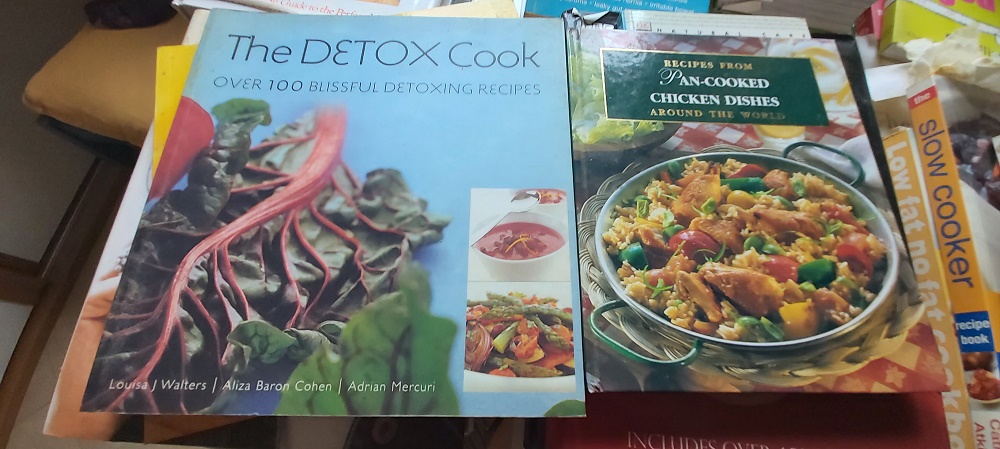
So, where do I start? May be with these two?
Where do you discover new recipes – online or in recipe books?
TWARTED
This week, I’d planned to bake ‘Olive, Bacon, and Cheese Bread’ for today’s Foodie Friday, but my plans are on hold as the only ham (one of the ingredients) I could buy from both supermarkets I tried contained only 86% meat. The other 14% contained goodness knows what else, and the ingredients didn’t read well. If you understand Portuguese, you may be able to translate. But even without translation, the list of extra ingredients didn’t look great in my opinion. And if I’m honest, it didn’t look like meat.
PROCESSED HAM
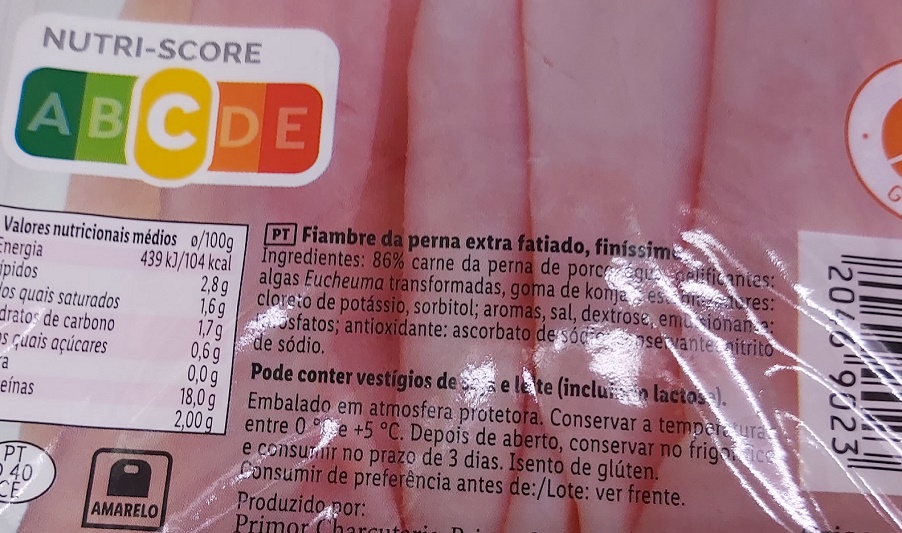
WHAT IS NUTRISCORE? I had no idea.
https://en.wikipedia.org/wiki/Nutri-Score
“The Nutri-Score, also known as the 5-Colour Nutrition label or 5-CNL, is a five-colour nutrition label and nutritional rating system[1] and an attempt to simplify the nutritional rating system demonstrating the overall nutritional value of food products. It assigns products a rating letter from A (best) to E (worst), with associated colors from green to red.“
I have seen nutri-score labels on some products, but I’ve never really paid much attention to them. Have you?
Now I’m off to see what other products I have in my fridge labelled with a Nutri-Score.
ETA strange that is the only one. Now I’m intrigued and on a mission to discover more!
REf: https://www.foodwatch.org/en/nutri-score-how-to-use-a-label-to-improve-health-and-diet
okay, it seems like not all companies have adopted it or, if they had, are reconsidering, and its use is probably in decline. Do you have similar food labelling in the US/Canada and beyond?
Interesting. I live to learn.
Moving on. Have you checked out Natalie’s Weekend Coffee Share?
Those are my thoughts on food for this week, folks. Happy cooking and eating!
Related Posts:

 Piglet in Portugal
I still use cookbooks, but I also get just as many recipes online. Recipe books can be so expensive and rarely will I make every recipe in a book. I haven’t heard of a nutri-score before.
LikeLiked by 1 person
Hi Kristin. Yes, books are expensive and I used to receive them as Christmas or Birthday presents. Not now though as I think most people search online.
LikeLike
I use online recipes most of the time. I haven’t noticed Nutri-score over here and a C doesn’t sound good. Thank you for your weekend coffee share.
LikeLiked by 1 person
Online recipes are simpler when you have specific ingredients you want to use. But it has at least made me dig out all my cookbooks and review what I want to keep as part of my drive to declutter
LikeLike
I have a massive categorized cookbook in Pinterest, Carole. I also made a private cookbook there that holds fave recipes from my hardcover books. I just snapped photos of the recipes and then created that book from the photos. It’s also categorized. My ocd-ish personality demands it, lol. I prefer using my iPad vs a hardcover book because it’s on a cantilevered keyboard stand so it sits nicely on the countertop. Also, I can scroll in on the print which is a big bonus.
LikeLiked by 1 person
Hi Terry, you sound SO organised. I have printed recipes scattered everywhere which I am trying to orgnise into categories. I have a lot of favourites on pinterest which needs organising. Hmmm … I think I am going to ahve a busy through weeks.
LikeLiked by 1 person
Great looking cookbooks. I don’t think we have nutriscore in the US. I don’t think a C is a great rating, and my rusty Portuguese says the added ingredients, like sorbitol and transformed seaweed, might be better to skip. xo
LikeLiked by 1 person
I need to sort through the books and rehome at least half pof them. I will never use all of them so best some find a good home.
Sorbitol and transformed seaweed does not sound apetising. I wonder why they would even do that. I realise some preservatives are probably needed and I also wonder if some are better than others.
LikeLiked by 1 person
I guess my words inspired you! Which is awesome. As I said I do love cookbooks for the visual and ease of use.
As to Nutriscore I have seen an odd item labeled this way but not many. I am pretty sure the ham from the store has formaldehye in it. Along with dextrose for sure. I do look at many labels and we really don’t eat a lot of super processed food except for the fact that I adore dark chocolate and yes it is definitely processed.
Bernie
LikeLike
Hi Bernie, Yes, you made me realise I have so many cookery books just sitting on the shelf gathering dust that I should go through them.
the formaldehye does not sound a good ingredient – I just looked it up.
As for dark cocolate I used to make my own from organic cocoa powder. We used to have a health shop that sourced only organic ingredients and then you weighed out what you wanted rather than buying prepackaged products. The tiny shop always had a quiue of people outside. Unfortunately it closed in COVID and never reopened.
I know the chocolate was easy to make and I used to buy organic dates and coat them in chocolate. They were wicked.
LikeLike