Author Jenny Grainer: “Portugal and the Algarve Now & Then”

Jenny recently contacted “Piglet in Portugal” (unaware she knew me through her monthly writing group), to ask if I would help promote her e-book through my blog. What a small world!

Naturally I was delighted to help.

Jenny’s book presents a great opportunity to learn even more about Portugal, past and present. Her book Firewater, potholes & sardines – stories of a Brit abroad (Portugal and the Algarve Now & Then) is now available on Kindle. Please check it out – you won’t be disappointed!

Portugal and the Algarve Now & Then

Portugal and the Algarve Now & Then

Reviews

“I came to live in the Algarve in 1965 and have watched an undiscovered corner of Southern Europe turn into the thriving tourist-orientated Province it is today. Jenny’s stories evoked many memories of those early days, when some of us were fortunate enough to share the lifestyle of farming and fisher-folk, whose land we invaded. For me, reading her book was a pleasantly nostalgic experience.” Harry Warner, Barbara de Nexe

“Required reading is this book of Algarvean short stories… nothing escapes her ears or eyes. Her style of writing is fresh and racy; I could not put the book down…” The Portugal News

“Jenny Grainer’s collection of very personal memories is an entertaining and absorbing read for any English-speaking tourist or resident who wants to know more about the Algarve’s recent history.” Algarve 123 Report

“Her wonderful descriptions of the characters she met are both sad and amusing and, to see Portugal through the eyes of a young Englishwoman, is at times a moving experience.” The Euro Weekly News

“Jenny’s book is a ‘must read’, as there are lots of short stories about the past and present of Portuguese life.” The Algarve Resident

“The wonders of life on the Algarve before it attracted the attention of developers have been recaptured…” The Portsmouth News

Jenny Grainer

Jenny Grainer

About the author

Jenny Grainer was born in England but has lived in the Algarve in Portugal since 1968. She has written for several national newspapers and in flight magazines and her regular ‘Now & Then’ column was so popular it became a book, currently being translated into Portuguese.

Jenny speaks Portuguese, teaches creative writing classes for English speakers and enjoys the ex pat and local social scene alike. Jenny lives with her husband Gordon in the Algarve and has 3 children.

Tales from France – Tete de Veau – bone out!

Reminiscing on the highlights of our recent French trip, to celebrate our Granddaughter’s second Birthday, the funniest moment (from my point-of-view) was a meal enjoyed at a local restaurant. Son-in-law kindly translated the menu and Mr Piglet chose the veal option. When his meal arrived, it looked the strangest cut of veal I’d ever seen. Served in slices it resembled a patchwork of greasy meat textures surrounded by a layer of gooey fat.

Tete de Veau picture courtesy of http://www.cheztse.com

Tete de Veau picture courtesy of http://www.cheztse.com/

Mr P poked and prodded the offering; tasted it, pulled a face then pushed his plate away.

“This is not veal,” he sulked.

“Yes, it’s veal’s head,” announced our son-in-law as he inspected then tasted said offering. “Look this part here’s the brain…”

He would have continued, but at this point I shook my head in warning. Mr P was turning various shades of puce green, and about to bolt for the door.

I’m curious, has anyone else eaten veal’s head without realizing?

If you’re curious here’s a link to a picture: http://www.goodfoodrevolution.com/wp-content/uploads/2012/10/tete-de-veau.jpeg

Better still if any of my French followers have a picture I could post, I will give you full photo credit and a link back to your blog.
Because boy in this case, a picture saves a 1000 words.

Tales from France – you must be joking!
“We’re going to make a Mickey Mouse cake for baby Piglet’s birthday,” my daughter announced.

Her words immediately triggered alarm bells in my head. I looked away from my computer aware this conversation needed my full attention. “We” probably meant “You” as in “Me”.

“Really?” my response was at best non-committal and even a little lukewarm. I knew my granddaughter loved Mickey Mouse, but a cake?

“Hmmm, yes. I’ve been thinking… no matter how it turns out it’ll be better than buying an impersonal cake from the local Pâtisserie.”

Great, I thought, she’s already self-managing her expectations which is encouraging. In the past I’ve found the French relatives ‘picky’ about food and rather superior when it came to fancy cakes, pastries and chocolates.

“Do you have the recipe?” I asked, trying to sound enthusiastic.

“No, I hoped you would.”

I groaned inwardly as I paused to consider the success of our last caked decorating venture. My only life-experience of making a themed cake, and then only as an observer, was over 20 years ago when my children, then aged seven and nine, entered their school Christmas cake decorating competition. Naturally, as the event was for the ‘children’ I encouraged them to make and decorate their own cake, as one would.

However, as they carefully applied the icing, crumbs of cake stuck to the knife resulting in a rather uneven surface – almost like the craters on the moon. The result looked like the cake had been dropped on the floor and then stuck back together. However, as their little faces looked up at me waiting for praise, what else could I say other than.

“Well done, it looks great!” Sigh…

The next day they proudly displayed their cake now titled “The Abominibal Snowman” on the judging table. As we all stared at the other entries I realised to my horror I’d let them down. Entries came in all shapes and sizes and all beautifully decorated to an extremely high standard. There were Christmas Trees, Nativity scenes, Reindeer and my favourite which was a cake in the shape of a roof with Santa peeping out of the chimney. Now call me cynical, but the jaw-dropping standard of entries were not cakes cooked and created by children.

My children looked at me for reassurance as the other contestants sniggered at their entry. I felt miffed.
“At least you can say you made AND decorated your cake,” I said as we walked away.

We are always wiser in hindsight…

I’m still reminiscing when I refocus on the conversation to discover not only did I have to bake the cake with a recipe I had yet to find (courtesy of Mr. Google), but to design it as well and shop for the ingredients. The scariest part however, was the fact that the thermostat on my daughter’s pigging oven was erratic and unreliable and would burn the cake to a crisp in a blink of an eye.

The next morning our shopping foray to L Clerk hypermarket to buy ingredients for the cake proved easier than expected. The only hiccup being you could not buy self-raising flour in France. Even as I write this, I’m still not convinced; France, the gastronomic centre of the Universe, does not sell self-raising flour. No way! I also discovered you could not buy rolls of pre-prepared icing, which you just rolled out and cut to shape. We decided to improvise and made butter icing which we dyed with Cocoa powder (brown) for the head, and pink for the face. Sorted!

Ingredients procured our next projects were to design a Mickey Mouse template for the icing and then bake the cake without cremating it. Success! So far, so good.

I made the icing and then deftly passed the responsibility of creating the shape of Mickey’s head and decorating the cake to my daughter while I poured myself a large glass of red wine. Up to this point it had taken us over three hours and I felt emotionally and physically exhausted. Our granddaughter’s birthday was the next day and guests were due to arrive at eleven; there was no time-margin for error.

I looked on in horror as history was about to repeat itself, but this time I was a little wiser.

“You need to spread the icing with a wet knife.”

“Why?”

“It gives a more even layer and you won’t end up with half the cake in the icing,” I said, as I demonstrated the process to my daughter and son-in-law who had now joined us in the kitchen.

Two hours later although the cake was finally finished we were also rather tipsy.

Mickey Mouse Birthday Cake

Mickey Mouse Birthday Cake

I’m not sure what my Granddaughter thought of the cake, but the French relatives were impressed and even asked for a second helping!

Read more stories about my adventures in France

Memories of a French Christmas
Baby Piglet and Language Problems
Frozen Condoms in France!
An Emotional Rollercoaster
A Turkish “experience” in France

Piglet’s Plot in April

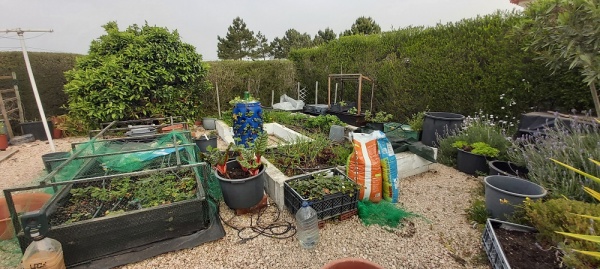
This year I’m keeping a photographic diary of my humble vegetable garden. In theory, if I take photographs on the 19th of each month they will offer a direct comparison as to what’s growing when, where and how well. The purpose of the exercise is to provide a record for next year so I can learn from my successes and, hopefully my not too many failures.

Piglet's Plot  19th April

Piglet’s Plot 19th April

Weeks of nigh on continuous rain has resulted in my broad beans developing rust. Apparently rust is an airborne fungal infection.

Useful tip from The Greening of Gavin

You can spray the fungus with a 1 part milk to 10 parts water mix which also works on powdery mildew on any of the cucurbit family (zucchini, cucumber, pumpkin, squash).

I hope he does not mind me quoting his words, but I thought the tip was worth sharing. Unfortunately, I ignored the signs and lost my remaining crop. A valuable lesson learned for next year!

Rust Attacked my Broad Beans

Rust Attacked my Broad Beans

Thankfully, I did manage to harvest several kilos of favas (broad beans) before I removed the infected crop. Check out my delicious Salada da Favas.

Favas (Broad Beans)

Favas (Broad Beans)

The onions, planted in mid November continue to thrive.

Onions

Onions

Much to the delight of the snails and slugs the french bean seeds, planted on the 13th March, are peeping through the soil . In desperation I did scatter some organic slug pellets. (Piglet hangs her head in shame). However, an army of ants removed them in the dead of night.

French Beans

French Beans

This year I only planted four red cabbages. Last year I planted twelve which was far too many.

Red Cabbage

Red Cabbage

Fruit Trees

Nespra (loquat) tree

Our nespra (loquat) tree is now 6 years old and this is the first year we’ve had an abundance of fruit. In fact, I’ve even made some nespra and onion chutney.  Researching loquats on Wiki I discovered they are high in Pectin. I think I will freeze some and then add to my strawberry jam.

The loquat has a high sugar, acid, and pectin content. It is eaten as a fresh fruit and mixes well with other fruits in fresh fruit salads or fruit cups. The fruits are also commonly used to make jam, jelly, and chutney, and are often served poached in light syrup. Firm, slightly immature fruits are best for making pies or tarts.

Nespra Tree

Nespra Tree

Orange Tree

Last year we had blossom, then tiny oranges however, they withered and died for no apparent reason.

Finally some blossom on my orange tree

Finally some blossom on my orange tree

This year fingers are firmly crossed the oranges will set and we will be eating our own home-grown oranges by Christmas.

Fruit trees growing in containerS

I now have three peach trees growing in pots which were all looking healthy until two developed a strange disfiguration to the leaves.

Problem with peach tree

Problem with peach tree

growing Fruit and Vegetables  in containers

Green peppers

This is the sole surviving green pepper from the plugs I planted back in February. It’s a tenacious little soul…

The pot is a recycled plastic paint container.

Red Pepper

Red Pepper

Strawberries

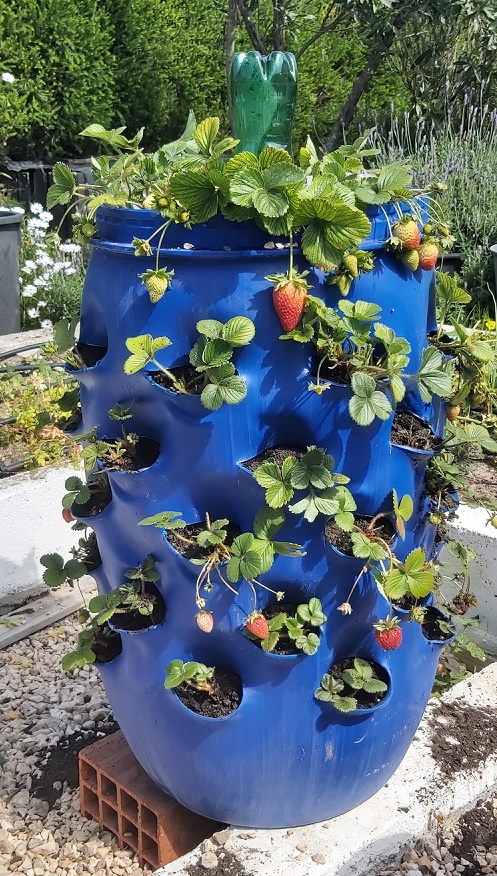
My strawberry plants just started to yield a bumper crop and we went away for two weeks. Sigh… Still there were still plenty when we returned. They are so sweet and far more flavoursom than the forced strawberries we used to uy in the supermarkets.

Strawberries growing in a container

Strawberries growing in a container

raspberry bushes

I’ve never grown raspberries before, not even in the UK so not quite sure the best way to care for them. I have three growing in pots and another three in the ground.  All are doing well, so fingers crossed.

My first raspberry flowers

My first rasberry flowers

Baby Leaf Salad

I only planted these on the 13th March! Have you noticed the container in which they are planted? This is definitely pushing the meaning of “salad bowl” to the limits.

Growing Baby Leaf Salad in a Container

Growing Baby Leaf Salad in a Container

Cucumbers in pots

I inherited these baby cucumber plugs from a friend who mistakenly bought them for zucchini.  The plastic collars (made from water bottles) will hopefully deter the snails. However, the snails and slugs in our garden all possess Olympic gold medals, so I doubt it

Baby Cucumber Plants

Baby Cucumber Plants

Aubergine plant growing in pot

I bought two aubergine plugs back in February. One I planted in a pot, the other in the ground. My intention was to make a direct comparison, month by month. Unfortunately, I forgot to take the other photo. If I had a brain I’d be dangerous.

Aubergine

Aubergine

Mystery plant

This pot was originally home to cucumber plants which fell victim one night to snails on a recki mission.  Then about a week later, three seedlings appeared from nowhere. I called them a gift from God, because was I cursing those wretched snails. I don’t know what these are – maybe melons?

Mystery Plant

Mystery Plant

***********

Notes
20/3 Harvested first crop of broad beans planted from seed on the 24/10
1/4 I bought another fig tree (green fig)
1/4 planted 12 perpetual spinach and 4 cucumbers

Weather in April
Cold and wet!

Related posts
Recipe: Salada da Favas
Piglet’s Plot in February
Category Archives: Growing fruit and vegetables in Pots
Category Archives: Growing Fruit, Veg and Herbs

No Way!

You must be pigging joking!

You must be pigging joking!

When I saw the theme for this week’s Weekly Photo Challenge was “UP”, I immediately thought of this photograph! No, I was not persuaded to climb up a snaking ladder to the top of this enormous slide. As I pointed out, I may be cabbage looking but I’m not completely mad.

So, who’s daring enough to try one of these slides?

Piglet’s Salada da Favas – Broad Bean Salad

My original idea was to try Chica’s recipe of Broad Beans with Griddled Pork Belly, but silly me left the shopping list at home and I forgot to buy avocado pears. This is my version of the recipe which I served up hot one day with roast chicken, and as left-overs the following day as a salad. This is not only simple to prepare but absolutely delicious.

Piglet's Favas Salad

Salada da Favas

Ingredients
Broad beans
Lardons (chopped bacon pieces)
Chouriço Sausage (Pimento)
Chopped Garlic
Pepper
Olive oil

Method
Fry lardons and chouriço sausage until crispy in a dash of oil.
Just before they are cooked add the chopped garlic and fry for a further minute. Drain on some kitchen towel to remove excess fat.
Gently steam the broad beans (favas) until they are soft, but the skins have not gone all crinkly and hard. (I tested the largest bean with a knife.)
Once cooked put in a pretty serving dish and mix in the lardons and chouriço sausage. Season with pepper or chili pepper as preferred.

Serve hot or cold

**********

We’ve had a great harvest of beans this year despite the plants being attacked by rust and then a plague of black fly.

Favas (Broad Beans) grown in my garden

Favas (Broad Beans) grown in my garden

Feira da Sopa in Rogil

We’ve attended many fairs and festivals in Portugal, however this has to rank as not only the most interesting but the most humbling lesson in social integration and how welcoming a small community can be.

The day of the “Feira da Sopa” (Soup Fair) dawned cold, damp and miserable. In fact, it was the sort of bleak February day where you could quite happily stayed at home curled up in front of a roaring log fire with a good book and not travelled miles to visit a soup fair.

My favourite Sopa do Mar at the Feira da Sopa in Rogil

My favourite Sopa do Mar at the Feira da Sopa in Rogil

When we arrived black clouds loomed ominously so you can imagine our relief when we discovered the event was held in what can best be described as the village community centre. Not knowing what to expect we tentatively entered the hall where a throng of people had already gathered and were all talking at once. If you are unfamiliar with the area, Rogil is a typical farming community in the Western Algarve. Families have lived there for generations, and as such, are a very close-knit community. The atmosphere, although welcoming, reminded me of a large family wedding, and us neither guests of the bride or groom.

Tables and chairs were neatly arranged round the edge of the room with a large space set aside for dancing. We made ourselves comfortable and “people watched” as we waited patiently along with all the other spectators. The organizers arrived, set up displays, tested the microphone and generally stood around clutching clipboards and looking important (busy).

According to the poster advertising the event it started at 15.30 hrs, but of course it didn’t. The trouble is, being typically English we have this fixation about punctuality and we can’t seem to grasp the simple principle that NOTHING in Portugal EVER starts on time. Honestly, you could train your pet dog quicker!

Fortunately, the bar did open on time so armed with large plastic cups full of rustic red wine (aka courage) we mingled with the locals trying to discover exactly what was happening, or going to happen. Now in a country where you speak the lingo this is easy, but not when you don’t. I soon realised, as my friends looked at me expectantly, that the boundaries of my pidgin Portuguese just did not extend to the finer points of a “Feira da Sopa”, especially without any previous frame of reference to draw on. The only facts I knew for certain were: there was soup (maybe free), music and dancing. However, it soon became clear as we “mingled” that we were strangers and the only non-Portuguese speaking people in the room.

People arrived, carefully carrying large soup pots of various shapes and sizes, and directed to a long table. We watched proceedings with curiosity as each pot had its own dedicated space and a sign describing the soup along with a list of its ingredients. I take numerous photographs, and thanks to my exceptional powers of deduction, I concludethere are two types of soup – Sopa da Terra and Sopa do Mar – I translate these to mean “ Soup of the Land and Soup of the Sea. So far so good, but what did we do? We are still puzzled.

Waiting to be judged

Waiting to be judged

We then discovered a stall selling terracotta commemorative soup dishes so keen to support the event we bought one each. Besides, how else would we eat the soup?

While mingling and taking photographs my friend fortunately met someone who spoke English and the missing pieces of the puzzle finally came together. This was Rogil’s first “Feira da Sopa” which is actually a soup competition. Suddenly as the mist of confusion lifted we looked at each other in one of those special “ah hah” moments! Apparently, each competitor cooks a soup which is assessed by the panel of judges. Once the judging process is complete, the public, that’s us, can try all the different soups free. Now I know why there were so many people standing around with clipboards – they are the judges waiting for all the competitors to arrive with their soup.

As the judges tasted the various soups, pulled faces and made notes the competitors looked nervous, and I felt nervous for them.

Judging at the Feira da Sopa in Rogil

Judging at the Feira da Sopa in Rogil

A crackling noise from the microphone, followed by a high pitch whistle of feedback demanded our attention; one of the organisers was on stage and about to make an announcement. As he spoke with joviality his words accentuated by vigorous shoulder shrugging and expressive hand waving, I tried desperately to translate. Our friends looked at me expectantly; almost willing me to understand as if by praying for divine intervention, I would miraculously understand. However, there was no divine intervention, and no miracle. My limited grasp of the Portuguese language left me feeling frustrated and inadequate. Why, despite extensive study, do I seem to have such a mental block with languages?

We looked to the other spectators for inspiration. The judging complete, competitors served their soup to eager spectators and like lemmings we willingly joined the nearest queue. We tasted all the soups including fish, cabbage and a delicious pumpkin and curry soup which we later discovered won first place in the “Sopa da Terra” category. Emboldened by several glasses of “courage”, aka red wine, and several bowls of hearty Portuguese soup I quickly overcame my initial shyness as I attempted to make polite conversation in Portuguese, while I stood in the queue.

Dancing at the Feira da Sopa in Rogil

Dancing at the Feira da Sopa in Rogil

As the queues dwindled and dancing commenced I noticed all the women sat in groups, while most of the men loitered by the exit from the hall and entrance to the bar. So the women danced together while the men watched. Fascinated, I listened to the accordion player, picked up the beat of the music and studied the feet of the dancers. The dance did not look that difficult I thought, so in a moment’s insanity I pulled my friend on to the dance floor and we shuffled round with four left feet between us. The dance, almost like a galloping two-step with extra steps thrown in here and there for good measure, is harder than it looked. Hoping for inspiration we shadowed other dancers who encouraged and approved of our efforts with a smile and a nod. I don’t know whether my fitness was an issue or the elderly Portuguese women superhuman, but as the last bars of music played I gasped for breath and mopped my sweating brow with a tissue.

Suddenly the music stopped, there was a hushed silence and the microphone crackled to life once again. We turned to see what was happening; all the judges were on stage and a hushed silence enveloped the spectators and competitors. Various announcements ensued then enthusiastically received with applause as some competitors were summoned to the stage and presented with a plaque. Ah ha, they are announcing the winners!

Announcing the winners at the Feira da Sopa in Rogil, Western Algarve

Announcing the winners at the Feira da Sopa in Rogil, Western Algarve

We thoroughly enjoyed the Feira da Sopa and look forward to discovering more Feiras across the Algarve and Alentajo in the future. However, next time I will take my dictionary and swot up on some relevant vocabulary beforehand.

Article first published at ExpatFocus.com

Related Posts

Is Language a Barrier to Social Integration in Portugal?

Silves Medieval Fair 2012 – Feira Medieval Silves

Feira dos Enchidos Tradicionais de Serra de Monchique

Silves Medieval Fair: 9th – 15th August, 2011

Festival da Batata-Doce de Aljezur

Boa Páscoa – Happy Easter!

Folar da Páscoa - Traditional Portuguese Easter Bread

Folar da Páscoa – Traditional Portuguese Easter Bread

I don’t have any pictures of Easter Bunnies or Easter Eggs, so hope a picture of Folar da Páscoa will suffice.

I’d planned to drag Mr. Piglet along to a Folar da Páscoa festival today. However, as it’s being held outside and the weather is SO awful I will have to wait until next year! Mr. Piglet breathed a BIG sigh of relief! First time I’ve heard him cheer because it’s raining.

Related posts
Folar da Páscoa

Good Friday in the Algarve

For those still trapped by the daily working rat-race of life how many times have you desperately waited for a Bank Holiday weekend, and then the weather is pooh? All week you’ve looked out of your office window longingly at the sunshine, counting the hours before you can escape. The big day arrives and then it rains! Not just spits and spots of rain where you can dodge the raindrops, or even a drab mist, but full on rain like a bucket of water thrown down on you from above.

Good Friday was one of those days. We went to the beach for lunch and not trusting the erratic weather we pre-booked a table inside the restaurant. Sure enough, right on cue, it started to rain – again. Being Easter weekend the place is packed with holiday makers. We noticed some Swedish tourists, who, unable to reserve a table inside the restaurant, sat outside on the terrace. Unfortunately, just as their meal arrived, down came the rain. However, unperturbed by the weather they improvised and finished their meal sheltering under their umbrellas.

Who cares if it's raining we are finishing our lunch!

Who cares if it’s raining we are finishing our lunch!

Even as write, I hear the rain hammering on our roof and gurgling in the gutters. As it lashes against the windows I draw the curtains to shut out the distorted images it creates and imagine the sun.

It is beautiful in the Algarve when the sky is a brilliant blue and the sun shines, but when it rains it is bleak and miserable. I feel so sorry for all those on holiday at the moment. I just hope they packed a good book and their water wings because apart from eating and enjoying the wine, there’s not much else to do.

Roll on summer!

You have to admire the Swedes tenacity. Would you have done the same?

Winey Chicken

This recipe is courtesy of Greedy Girl’s Diet: Eat yourself slim with gorgeous, guilt-free food with permission of the author, Nadia Sawalha

I am always keen to try new recipes especially those which are filling yet with not too many calories. My biggest problem with losing weight is that I usually only have to look at food and I pile on the pounds! However, at only 211 calories per serving this recipe from the “Greedy Girl’s Diet” is not only low in calories but absolutely delicious! Tip for busy dieters: Winey Chicken is simple to make AND if you cook enough, as I did, you can reheat the following day and hey presto a “Ready Meal”! I love the little heart croutons (I cut these by hand) and have stored the idea in the old memory banks for next Valentines day.

Winey Chicken

Winey Chicken

Winey Chicken

(211 calories per serving)

SERVES 4
½ tbsp olive oil
1 medium onion peeled and very finely chopped
about 100g • 3½ oz button mushrooms halved or left whole
2 tsp tomato purée
small glass of white wine (I said ‘small’!) about 100ml • 3½ fl oz
250ml • 9fl oz chicken stock made from liquid concentrate
4 chicken thighs or breasts (skin removed) sliced or left whole
1 tsp cornflour mixed with a little cold water
sea salt and black pepper
TO GARNISH
4 tbsp finely chopped fresh flat-leaf parsley
FOR THE PRETTY CROUTONS
3 slices of brown bread
olive oil spray

Heat the oil in a non-stick casserole and fry the onion really slowly until soft but not coloured. If the oil doesn’t seem to be enough, splash a little chicken stock in, too. Throw in the mushrooms and cook for a few minutes, stirring all the time.

Now add the tomato purée and, still stirring, fry for 30 seconds. Pour in the wine and bring up to the bubble, then add the stock and the chicken. Simmer over a really low heat for 25-35 minutes until cooked through. (If you are using breasts, they will take less time – approximately 15-20 minutes – and even less if sliced.)

While the chicken is cooking, make the pretty croutons. Using a cookie cutter, cut the bread into little heart shapes. Spray with oil and fry in a hot non-stick frying pan until golden brown, 2-3 minutes per side; set aside.

Little heart toasts

Little heart toasts

When the chicken is cooked through, take it out of the sauce and set aside on a plate while you thicken the sauce. Whisk the cornflour mixture into the pan and simmer until the sauce thickens.

To serve, put the chicken back into the sauce, taste and season if necessary, sprinkle with the parsley and adorn with your beautiful heart-shaped croutons.

ENJOY!

If you like the idea of eating yourself slim do check out Nadia’s book.

Greedy Girl's Diet

Greedy Girl’s Diet

Greedy Girl’s Diet: Eat yourself slim with gorgeous, guilt-free food

Related post: Delicious Cumin-spiced Carrot and Butternut Squash Soup